Nothing ever goes fully according to plan when there is one, right? In Denver, heavy delays on the outbound leg to Washington left us wondering whether we were even going to make the evening departure to Cape Town. What caused the delay was never known, yet the crew was made aware that many had tight connections, evidenced by the fact that many hands shot up when those passengers were asked to raise their hands. Come to find out, there were 14 people continuing to Cape Town - who would have guessed that there was that much traffic between Colorado and South Africa in the off season?
With an arrival time now estimated to be almost exactly that of the departure time of the next flight, the crew of the second flight was gracious enough to wait on the last passengers; another feeder plane from Los Angeles which also carried a portion of the Cape Town passengers arrived immediately after us. Added to this was the fact that my parents had a high status at United, and that the Washington - Cape Town service only flies every two or three days, so they would have waited regardless. At the gate all of the last few nervous passengers made jokes about missing the flight.
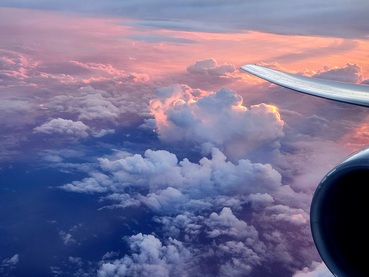
The second we sat down, the doors were shut, and we were on our way. Sitting so far forward in the 777 was a special experience. The airplane equipped with capable GE 90 engines thundered out of DC with a buzz incomparable to any other aircraft. A bank past the city of Washington would be the last thing I saw before we viewed the sunset and ventured into the cloudy Atlantic nighttime. I had ginger beef and a top blade steak with some new movie playing before getting 6 hours of spotty but well needed sleep.
The 14-or-so-hour flight didn't quite feel like it. With 2 hours left a breakfast was served, and soon enough the outer edges of the Cape came into view. The captain took us over the towns of Fish Hoek, where I caught a glimpse of Boulders Beach, before bringing us down over the townships of Mitchells Plain and Khayelitsha. I had for a long time known about the country's Apartheid history and had been fascinated by the massive disparity of how people live - but one really gets a feel for this widespread issue when witnessing the expanses of shacks from the airport's approach.
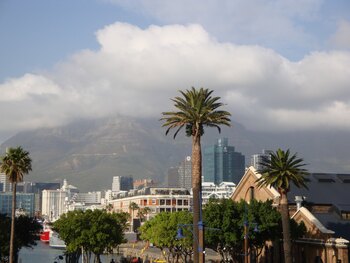
Upon picking up our duffels, we were greeted at the passenger pickup area by Noel - the guide who would be driving us around the greater Cape area for the next four days. We instantly picked up on his friendly personality and warm smile. As our flight landed in the late afternoon, there wasn't much time left for any sort of activity. He did, however, do his best to explain some of the sights one sees on the drive to from the airport to the waterfront. For one, seeing Table Mountain with my own eyes for the first time was nothing short of breathtaking. However, the very first thing that anyone sees when leaving CPT is a massive slum lining the highway, something that he made sure to point out right away.
I actually did appreciate his openness to any questions about South African society, about both its good and bad sides, and planned to ask him more about his experiences growing up over the coming days. The Cape Town city center, in contrast, actually looked very developed and modern. Those who don't know any better could easily take it to be a European city. The V&A Waterfront is where most visitors stay and spend their time, as it is surprisingly safe. Upon arrival at the Portswood Hotel, we made some minor changes to the itinerary for the coming days and promptly went out for dinner. The Breakwater Lookout Point provided us with an excellent sunset and the clearest evening sky we would have for the whole time in Cape Town.
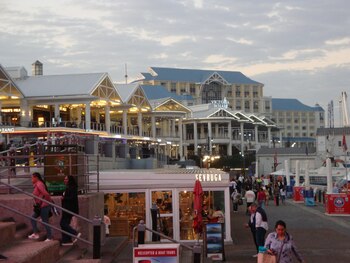
Introducing the Victoria Wharf Shopping Centre - a very modern and clean mall, where we would soon spend every evening eating and shopping. Right at the Waterfront was a line of restaurants inviting any and all passersby to come in and dine. And that we did upon recommendation, first at Karibu, which unbenownst to us at the time was simultaneously rated the best African cuisine, steakhouse, and waterside restaurant, as well as best South African cuisine by Haute Grandeur. An excellent way to get to know Braai - the South African barbeque tradition, consisting of various grilled game including but not limited to ostrich, springbok, kudu, and warthog. My parents' new obsession: Beyerskloof Pinotage 2020 wine. And my new obsession, the popular South African dessert: koeksisters. A colorfully-dressed local song and dance group came thundering down the main restaurant row, singing traditional songs much to the appeal of the hoards of tourists sat outside. By this time the winter chills settled in, which was odd coming from hot Colorado.
This was our "day at leisure" as per the itinerary. We figured it would be the prime opportunity to take the hop-on-hop-off bus service that runs through the city regularly. But first, breakfast at Den Anker, a small Belgian brunch place that offers excellent views of the Bascule Drawbridge and the small boats exiting the adjacent marina. The morning was sunny and relatively temperate, but that would be the last we would see of the sun that day.
A lengthy stroll throughout the waterfront ensued. Lots of luxury apartments and condos with direct access to the marina. And what visit wouldn't be complete without falling for one of the tourist traps? I checked that box off when taking a short video of local marimba band in the street, who subsequently invited me to play for a few seconds, then charged me and made me buy a CD of theirs. Whatever, lesson learned.
The bus ride was very enjoyable if not a little bit cold. I subjected myself to this cold in order to take photos and videos. First we cruised around the entire waterfront and saw all the sights we had already seen on foot in addition to the famous boat repair docks. Then we went into town, a very eclectic mix of skyscrapers, old European colonial buildings, Dutch names, and colorful houses. Legitimately, every element of the experience made it feel like Europe, from the climate, weather, city style, and especially the names of everything. The bus held at the Table Mountain Aerial Cableway station, where we got a cloudy view of the city from above. Impressive at the time, but incomparable to the views we would have in the coming days.
Down to Camps Bay, which was the spot I wanted to see on foot. The audio guide made sure to inform us that houses in the price range and quality of those found on the cliffsides of Camps Bay and Clifton are the exception, and that the vast majority of South Africans cannot afford to live like that. From the beach down below, you could look up and see endless neighborhoods lined with palm trees, expensive cars, and panoramic windows. To say I had stepped foot in the ocean there, I dipped my feet in the water, something I instantly regretted upon feeling how cold it was. It was pretty, but Camps Bay is better enjoyed in good weather to say the least as it was cloudy, cold and drizzly. Not to mention the endless vendors relentlessly annoying anyone who looks like a tourist - the less tourists there are, the more likely you are to be targeted by their sales pitches of the same artwork that every other vendor also mysteriously sells.
The next bus soon picked us up from Camps Bay and continued down the length of the coast, crossing through the towns of Clifton and Sea Point. Just rows and rows of penthouses and luxury highrises all the way up to the waterfront. Nice area, sure. Not somewhere my family would want to live. Everywhere you look, you get a feeling of the old money and foreign investment that makes the neighborhood what it is.
As we drove past the DHL Stadium, the pre-recorded voice told us the interesting story of how it actually used to be an unattractive place to live, and how it is now the highest-valued real estate in the whole of the country, if not the continent. These properties had been passed down through the generations and modernized extensively. The driver let us out where we got on.
Next we checked out The Watershed, a marketplace with locally designed and created artworks and souvenirs. Here, I bought myself a handmade bucket hat. There was no shortage of paintings, wood carvings, clothing, jewelry, and other crafts. In particular, a photographer's booth selling prints caught our attention. He had taken stunning wildlife photography of Etosha, the place we would be traveling to in few days. With his sellers, we had a lengthy conversation about photograph settings.
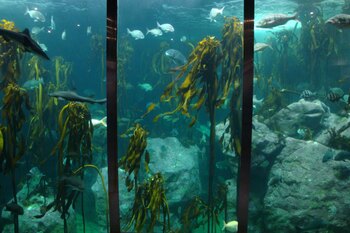
Upon request from my mom, we then went into the Two Oceans Aquarium. I myself an not the biggest aquarium-goer; however, I found myself pleasantly surprised at what the place had to offer. We saw a wide variety of corals, jellyfish, rays, eels, sharks, and starfish, which in itself is not that out of the ordinary for aquariums. But what set this one apart was its exhibit on penguins, which are critically endangered in the Cape. They had African and Rockhopper penguins in an enclosure, but it was very interesting to learn about the former and current habitat range, their lifestyle tendencies, and how the conservation organizations are doing everything they can to prevent the expected extinction of the ~10,000 breeding African penguin pairs remaining in South Africa by 2035.
I was so cold on the bus earlier that I was wearing my puffer jacket the whole time despite it being only relatively cool out. After dinner just outside of the same shopping center, we decided to join the large crowd gathered outside of the mall, watching the India-South Africa T20 Cricket final in a small amphitheater. Despite me having zero knowledge on how cricket works, it was thrilling to watch. Right afterward, we decided to enter a small, quiet nearby bar and watch the Germany-Denmark soccer game. It was interesting being in the same time zone as the Euros and actually being able to watch in the evening instead of early in the morning. As the day came to a close, the city became shrouded in fog.
This day was all about wine. No visit to Cape Town is complete without at least sampling some of the wide variety of South African wines. We had already been primed - Pinotage had become one of our new favorite types of wine. Now it was time to see where and how they got made.
Noel picked us up bright and early to drive us through the city and out to the winery fields near Paarl. As we passed through the foggy, fairly well-off suburbs of northern Cape Town, he told us the entire history of South Africa from beginning to the colonial eras to Apartheid to the modern-day and painted us a very holistic picture of the country. He explained the geography of the country, how wine was introduced to this very fertile part of Africa from Europe, and told us that its main highways could take you to Egypt if you wanted.
What really captivated me was his explanation of the people, racial issues, and languages. How segregated the people really were during Apartheid and how they were confined to live in certain parts of the country against their will. How some cities despise using the "colonizer language" Afrikaans, how some almost exclusively use it, and how some cities like Durban are more Indian, for example, than anything else. How whites still own most of the wealth after all these years. How the black youth felt there should have been more of an uprising. How Christianity took its hold on the country. How Johannesburg had a booming gold rush. How the upper classes of South African society neglect and ignore the problems of the poor and how little was done to accomodate the influx of black Africans to the cities. And perhaps most disappointing of all, how hopeless it is for those at the very bottom to escape the system's confines - they don't know any different and accept life for what it is. Because while seeing the country's beauty is amazing, one also needs to see the whole picture. He would proceed to tell us more over the course of the day.
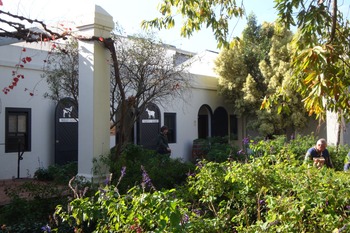
The first winery we stopped at was called Fairview Wine & Cheese. This wine estate specialized not only in the production of its Fairview branded wines, but also goat cheese. I selected to try a combination of White, Rosé, Pinotage, Malbec, Shiraz, and Homtini wines while pairing them with the appropriate cheeses. It was incredible. While my palette is not as refined as that of my dad, I did my best to distinguish the different characteristics of each wine, while chatting with Noel about me finishing my studies at college.

The winery was truly gorgeous with its reflective pool, vines growing along the entire estate, and goats living out front. Rather than taking us to the next winery, we decided to check out the town of Stellenbosch first. The university town, with its quaint main road, large student body, red roofs, and mountainous background had a striking resemblance to my college town of Boulder, CO. Cute artist shops and cafés lined the roads, surrounded by student housing, intertwined with fancy white columns and churches.
Upon taking a brief stroll through the seemingly very livable town, we realized it was about as Afrikaner as you can get. The university student body is apparently over 90% white, with Afrikaans and subsequently English being printed on all signage. Only a few years ago was IsiXhosa adopted as the university's third official language. Everything was developed and nicely kept together, and with the mild temperature and wintery trees, I again felt as if I was in Europe. It made a very good impression. And in true South African style, a massive shanty town on a hill overlooked the developed town below.
Up next - Franschhoek, or "French Corner" in Afrikaans. Another quaint, developed, slightly smaller wine town a half hour's drive away, very walkable and attractive, and obsessed with France due to the quantity of French wine they cultivate here. We ate a brief curry lunch here and continued to the next winery.
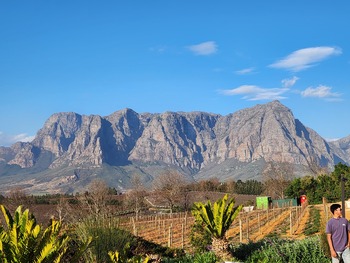
Eikehof Wines - just up the road from Franschhoek - was incredible. The backdrop of the Jonkershoek Nature Reserve perfectly complimented the smiling faces and friendly workers that immediately engaged in conversation and greeted us with complementary rosé. In their backyard, another family was having a reunion-type event while we sat down, took in the gorgeous scenery and amazing decorations such as the old rusty 1942 Ford Cape truck that the previous generations used to harvest their grapes. And their wine selection was as wonderful as the first. Plenty of complimentary French wines were poured into our cups while the waiter (or wine presentation guy?) practiced his German on us and told us about himself. It was here that my mom had her hilarious encounter with Jimmy the ostrich after being convinced to feed him, sparking a new love for the curious birds. A quick photoshoot and we were soon off to the next place.
As we were a little behind schedule, we had to skip the final winery tasting, but stopped by the Delaire Graff Estate either way to see its fascinating sculptures and luxurious interior. At their price point, however, we were glad that that was all we stopped to do. The estate had an amazing view directly onto the vineyards and the mountains right behind them. We took a family photo in front of these mountains and made our way back to Cape Town, driving through a myriad of otherworldly landscapes on the way home. Noel told us more about the expansive Khayelitsha shanty town and township that a staggering 1.5 million people call home, and their hardships. While depressing to see, I learned a lot and valued his expertise on the matter. Back to the waterfront, where a dinner next to the locations of the previous dinners was the final activity of the day.

The first day of July was another day partially at our leisure. We met up with Jason, a tour guide that takes people through various routes up to the top of Table Mountain. Originally we were supposed to hike up Skeleton Gorge, but with concerns of it being too challenging we asked Noel to change our planned route to the Platteklip Gorge, which was apparently easier. At the starting point, we set foot in a foggy environment.
The first 15 minutes were gorgeous. Through the mountains and fog we navigated through narrow passageways and natural stairs. Eventually we reached the last exit point trail which would lead you back down to the Table Mountain Aerial Cableway station, and we as a group were not fit to continue as the trail would soon become steeper. There were some pre-existing injuries that made continuing impossible. We decided to bail and took that alternate path back down. For a bit we stayed level with the side of the mountain before descending, walking between mossy faces of stone, overhangs, and dripping water coming off the cloud of fog passing through.
Along the way Jason stopped us a few times to tell us some geological facts, as well as the work that he does out in the townships to pull children out of poverty through sport. With a charity that he runs alongside being a tour guide, he aims to prevent the youth in the townships from getting involved in gang activity, and coaches several age groups of children's soccer to provide them with something to look forward to. It was an inspirational, yet also a humbling story to hear. At the same time it was also another fantastic opportunity to trade life stories.
From the cable car station, we were able to take the cableway to the top. The cable car features only two cars, each capable of carrying upwards of 60 people and rotating 360 degrees so everyone can witness the view going up - the view being the thick cloud layer that blocked everything for the entire duration of the ascent. Even upon exiting the station and walking around on the top of the plateau was there little to see. For about an hour we walked around the top of Table Mountain surrounded by dense fog, taking in what little vegetation and eroding rock formations one was able to see before returning to the café somewhat disappointed, having a coffee and returning back down to the station.

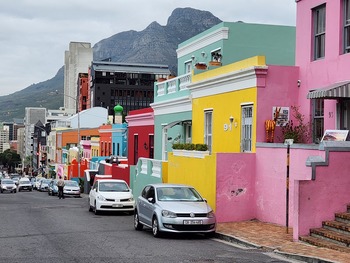
It was an important day for Noel due to personal reasons. So, we decided to let him spend the day with his family, and Uber around the city instead. For this reason we Ubered back to the hotel and subsequently to Bo Kaap, the colorful historical district that primarily Muslims reside in. The homes here look different to anywhere else in the city. It was mainly my idea to visit this part of the city and it was for exactly that reason. Upon arriving, we instantly recognized the call for prayer emanating from the several mosques nestled in between the houses painted in every color imaginable. As soon as the sun briefly peeked out, it made for the perfect photo opportunity. Walking through the incredibly diverse neighborhood, while gorgeous, was slightly sketchy. And it became even more sketchy when we suddenly got harassed by a child who witnessed my dad taking a photo of the street ahead. So we left, back to the hotel briefly.
Then, I had another idea. The sky was clearing up. Why don't we go back up to the Table Mountain Aerial Cableway station, to see if we can watch the sunset and make up for the view that we didn't get earlier in the day? It took a little convincing, but when my parents saw that the weather was clearing up, they agreed. So back we went, and again we found ourselves in the cable car.
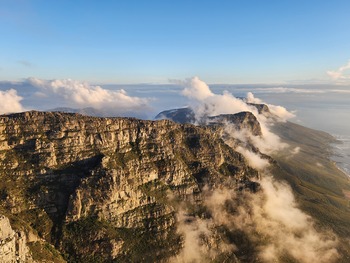
Once we got to the top, I witnessed some of the most gorgeous views I have ever seen. On one side, a beautiful view down onto the city that stretched so far that you could even see the outer suburbs of the city. On the other side, a breathtaking sight of Camps Bay and the coast immediately south of it. The row of peaks lining that coast and providing the background for most Cape Town postcards, the 12 Apostles, had the perfect amount of condensation combing through their valleys to create a stunning effect. The upwards flow of the wind pushed the few clouds up every side of Table Mountain, making for some excellent timelapse videography. What's more, the sun's reflection off the Atlantic waters perfectly silhouetted the visitors on the western balcony as well as Lion's Head. The wind was surprisingly calm. I couldn't stop taking pictures and neither could my dad.
As the sun began to go down, we realized we had to hurry to get down the mountain as we were about to catch the last scheduled cable car for the evening and hundreds were still on top of the mountain. The light turned red as we went down, unfortunately causing us to miss the moment of sunset. Once we returned to the waterfront, we ate at a food hall, where my family shared some sushi and ramen. We spent some time looking for some more safari-adequate clothing, roaming around various activewear stories. For fun, we returned to Karibu that evening, just for dessert and nothing more. Another order of koeksisters and another evening song and dance show later, we were ready to get some sleep for the final tour the following day.
Noel picked us up from the hotel bright and early to take us on our final tour down the length of the Cape Peninsula, with numerous stops along the way. In the White Toyota, we first drove once more through Sea Point, Clifton, and Camps Bay, stopping in Clifton briefly to take in the fresh morning sea breeze under a cloudy sky. For a minute he told us some of the same information we learned on the bus tour as we watched the waves crash against the rocky shore.
The windy M6 took us past Llandudno and into Hout Bay, towns that both feature very upscale and high-end communities. Hout Bay struck us as a very cozy town, with heavy foliage blanketing the large estates we were driving past. For a few minutes we stopped at a local market in the Hout Bay Harbor, where we took in views of the cloudy bay, looked at some artworks, and witnessed seals swimming between the parked boats.
Noel informed us that typically he would continue to take guests down the M6 past Chapman's Peak, one of the country's most scenic drives. Unfortunately for us it was under seasonal construction. Instead we briefly parked at a trailhead a little bit up the road, took in Hout Bay from the other side, received a brief history lesson about the historically colored neighborhood that sits at the foot of The Sentinel, turned around and continued back into Cape Town through Constantia. Along the way, we were once again reminded of the stark contrast of the region's living conditions upon seeing the Imizamo Yethu shanty town built quite literally in the backyards of mansions.
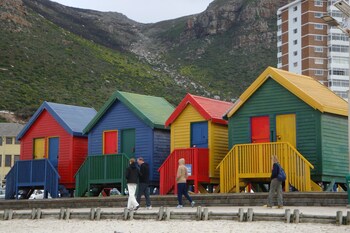
Next stop: Muizenberg. This vibrant southwest suburb of Cape Town is known for a few things - surfing, colorful beach huts, and supporting a young, active population. Despite the sun only peeking through the clouds for a brief moment, the waters, which face False Bay, were full of people enjoying the water that was significantly warmer than those on the eastern coast. Noel would go on to explain how this was a result of the clashing Benguela and Agulhas Currents. Highrise apartment buildings peeked over the red, yellow, green, and blue rows of changing boxes, which in themselves provided fantastic photo opportunities with the background of the foothills. In our opinion, this beach town made a much better impression than Camps Bay, as it seemed more livable, genuine, and full of life. Combined with the miles of sandy beaches, this quickly became a new favorite part of Cape Town for my parents and I.
Onwards. There were still many stops ahead for us. We were subsequently taken through Kalk Bay, another small, beautiful town that lines the coastal M4 road. Another very seemingly livable and genuine town with tidal sea salt pools reminiscent of those I saw in Bondi Beach in Australia. Matter fact, the vibe of this entire region was very similar to Australia - developed, fun, well-equipped to support tourism, and evidently once British.
At the Kalk Bay Fish Market, we immersed ourselves in the intense fishy smell while strolling down the fishing vessels docked at the jetty. Children playing at the beach, seals lounging on the jetty, colorful cages everywhere. The seafood here is immaculate, according to Noel, who spends most of his free time here and in Muizenberg. Unknowingly, we stumbled into the set of a movie so we quickly got back in the car and continued to head south.
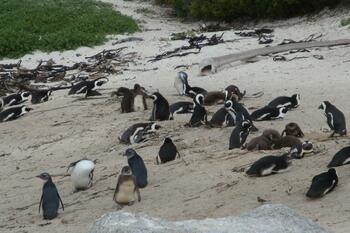
Past Fish Hoek and Glencairn, we reached one of the most awaited stops on our tour and one of the main reason people come to Cape Town - Boulders Beach. After a short walk within a neighborhood of Simon's Town, we reach the visitor center and the boardwalk, which if you follow all the way down to the end, will lead you to a resident African penguin colony. These penguins were everywhere. And so were the tourists, eager to take witness them. Some of the penguins were resting in groups on the sand and in the enclosed, protected bays comprised by the labyrinth of half-billion-year-old granite boulders, while others entered and exited the water. We were even lucky enough to see some baby penguins, with their mothers brooding. They tend to hide inside of the thick bushes lining the beach to hatch and raise their young. Showing no fear or remote regard for the hundreds of humans staring at them, they continued their activity while we spent about half an hour observing them. Incredible.
Continuing our southward journey, we learned more about the endangerment of these penguins and how the colony grew largely over the previous decades, thanks in part to ongoing efforts by the Cape government to ensure the food chain's survival. These African penguins, the same ones we saw in the aquarium, are apparently only found on South African and Namibian coastlines. We continued to see them and seals lounging atop seaside boulders along the remain length of the M4 until the entry point of the Cape Point National Park.

The landscape got progressively more and more barren, and the Cape Point Nature Reserve came into view. The winding road eventually led to a parking lot at which countless larger tour buses were parked. First through, lunch at Two Oceans, a seafood restaurant located above a cliff providing astonishing views over the False Bay and all the way up the coast of the peninsula we just traveled down. All four of us ordered fish and chips. Plain, simple, and delicious.
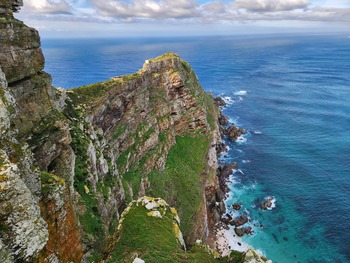
Where there is normally a funicular to take tourists to the Cape of Good Hope Old Lighthouse lookout point, was a replacement bus service. This bus hauled a load of tourists up an insane grade to the top of the hill, from where it was only a short hike to reach the lighthouse itself. There it was, the end of the continent. A huge grassy cliff face with turquoise waters crashing into the rocky beaches hundreds of feet below welcomed us here. My mom and I stood there in awe as we processed that we really were looking at the famed southeastern tip of the African continent.
The lighthouse, now defunct and covered in stickers from past visitors, featured a sign that pointed in the direction of many other European and North American cities. It was possible to take an additional hike to reach the absolute end of the peninsula, but we elected to take it in from the lighthouse. The expanse of the ocean was laid out in front of us, with the peninsula's length reflecting in the sun behind us. Just to the west was another cliff, with a boardwalk that could take you down to the beach below. The weather, luckily cleared up for us, and we went back down for a quick look into the "curio shop" before leaving with Noel. I wanted to make sure that our presence in this part of the world was made permanent by carving our initials into a stone near the lighthouse, as many, many others had done.
There was actually one more stop: the Cape of Good Hope itself, which was a short drive away from the tourist zone. This zone was the geographical southeasternmost point (not the southernmost or easternmost - these are not located here!) of Africa, denoted by a sign that we all took photos in front of. Here, it was possible to observe seals lounging amongst the rocks that waves were regularly and violently crashing onto. In the distance, and MSC cargo ship that was taking the long route around the world. Due to geopolitical developments around the world in the last decades, many ships have reverted to taking the Cape route to get to and from the Americas, as we found out. It was not just a backup route.
We passed many small farmers markets, rustic villages, and another shanty town belonging to Simon's Town on the way back. Upon explaining to us that this shanty town was safer than other slums due to lack of gang activity, Noel took the opportunity to tell us about his upbringing being labeled as a colored person in Apartheid South Africa. He explained to us the hierarchy of races set up by the government, and how colored individuals had a tough time even after Apartheid, as all jobs that were for whites were now delegated exclusively to black Africans, leaving the massive colored and Indian population out of the question. Noel was directly affected by this growing up as a half-Indian, half-British descendant, and appreciated me asking about his upbringing as he liked storytelling (as we had come to learn) and was waiting for the right time to tell us his. I was grateful that I had someone to ask all the tough questions to, as I had for a long time been interested in South Africa's unique and troubled history and how its citizens today cope with the wrongdoings of the past.
These stories he told us as we passed through the communities of Kommetjie and Fish Hoek, where it was once again very easy to see this prominent divide. We took the mountain route back through Constantia, and encircled the entirety of Table Mountain as we passed through the wealthy suburbs of Claremont, Rondebosch, and Woodstock. We thanked Noel for an incredible few days, showing us the absolute best of the town. Our last evening in Cape Town was spent back at the waterfront Ferris wheel, watching the sunset as we had on day 1, and shopping in the mall for a small duffel bag. There were a few things we needed to leave behind in Cape Town to save weight for Namibia and pick up on the way back. For dinner, we enjoyed some Mozambican food at the waterfront mall.
We find ourselves at the Cape Town Airport, about to board the first intra-Africa flight of the trip. Our small Airlink ERJ-135 would take the cake as the smallest domestic jet I've flown. Our destination: Windhoek, Namibia. It was the first international departure of the day, and the airport was so dead that it felt like walking through an abandoned building. Quietly we ate our breakfast packages that had been packed by the hotel for our day, and said our last goodbye to Noel. Never has security been so relaxed and the boarding process so streamlined.
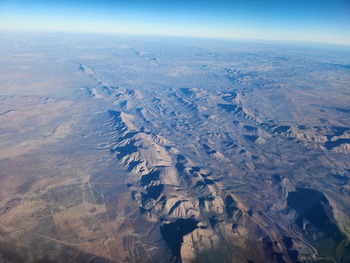
The bus brought us out to a very far remote stand, and it didn't take long for the door to be shut. The seating arrangement was two seats on one side of the aisle, and one on the other. Once airborne, I was surprised to find out that we would be given more food than any 5+ hour domestic flight in the states. As the sun peeked over the clouds of western South Africa, I got some more sleep before we descended over the canyons and mountain ranges of southern Namibia. As it was wintertime, the landscape looked particularly dry and arid, as not a cloud was in sight, in contrast to South Africa. An interesting mix of aircraft on the ground at Windhoek: a Qatar Air Force C-17 transporter and two large German aircraft that had both just flown in 10 hours from Frankfurt together to drop off hoards of Germans. It was apparent at the immigrations counter.
First order of business: secure the SIM card. Our family plan covered a limited amount of texts and calls in South Africa and Zimbabwe, but Namibia remained fully uncovered. I was shocked to learn at the airport that one pays for texts received and it did not matter whether you texted friends via wi-fi calling. How did we get around this? With my dad bringing two phones for this very purpose, he used his personal one to switch the SIM card to contain a Namibian number, enabling us to tap into the country's roaming data, use GPS, make calls, and send texts. We would be reliant on this one phone when not on a wi-fi signal.
Second order of business: secure the rental truck. Through Europcar we had reserved a Toyota Hilux. Similar to a Tacoma but marketed towards every country that is not the United States. We had to wait over an hour in a group of other German tourists for the two people working the Europcar facility to process the way through the masses that came before us. We knew Namibia was frequently most heavily by German tourists, but my God. Quite literally, almost every last tourist at this airport was German. By the time the paperwork was signed, the car was checked, bags were loaded, the safety video was watched, and Namibian tire pressure regulations were gone over, it was time to go. I set up my timelapse camera on the dash - I would be taking several timelapses over the coming 11 days as we would drive thousands of kilometers through the country, to 5 separate destinations.

Let's check in on the family - how is everyone doing? Mom, who has low appetite and faced her claustrophobia on a small plane, is not used to this much activity on a vacation, and is still recovering from being shuttled around Cape Town. Absolute trooper, but still having fun overall. Dad, on the other hand, is getting used to driving on the left, with the steering wheel on the right. Every few minutes he activates the windshield wipers instead of the blinker, adding some hilarity to the day's mood.
First we drove for half an hour through wide open spaces into Windhoek, the capital of Namibia. Briefly we entered into a small shopping mall, which had a Checkers grocery store inside. We needed a few essentials before setting off on our journey to Otjiwarongo further in the north, namely water, bread, snacks, batteries, and Biltong - a form of jerky traditional to southern Africa, which had been recommended to us prior. While the Namibian Dollar is fixed to the South African Rand, we figured it would be best to attempt to change the latter into the former at the checkout lane. Namibia has a heavy tipping culture, as we would soon find out upon tipping the security guard in the parking garage.
We spent no longer in Windhoek than necessary, as we were already behind schedule. The city had notable German colonial influences and was very clean and organized, despite people walking and selling on the sides of the road everywhere you went. You could tell which cars were tourists - they were all driving white SUVs or pickups of sorts. Most tourists that come to Namibia do exactly what we did and take a self-driven road trip to see all the country's attractions. Nearly all of them first stopped in Windhoek before embarking. We had to focus to make sure our driving was fine, and while I offered to alleviate my dad of his driving duties, we decided it was best for him to take control as we left the city heading north.
I couldn't believe we were just in Namibia. It had, for the longest time, been the #1 most fascinating country to me due to its wildlife, landscapes, and remnant German influence, and it was on the top of mine and my dad's bucket list for the longest time. And here we were, just taking the country head on in a nearly two-week road trip. The four hour drive would lead us close to the town of Otjiwarongo, our first stop. We soon realized how expansive the country was. Everywhere you looked, there were endless, open expanses of sheer nothingness. With rest stops every few kilometers, we were able to stop the car and eat our food along the way. The roads were fenced off with incredibly intricate fencing to keep the wildlife out, and every so often one would pass by a small farm or the entrance to a ridiculously remote nature lodge. Most fascinating of all - the thousands of countless 10+ foot high termite mounds, that you would see every few seconds, everywhere. Why Otjiwarongo of all places? This is the location of the Cheetah Conservation Fund.